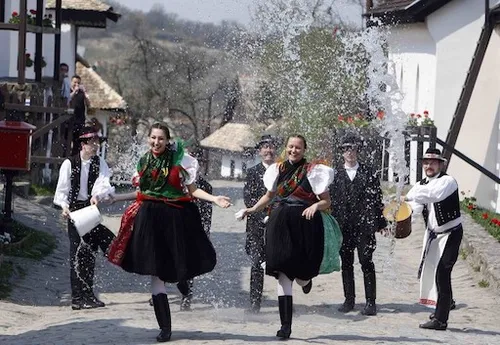
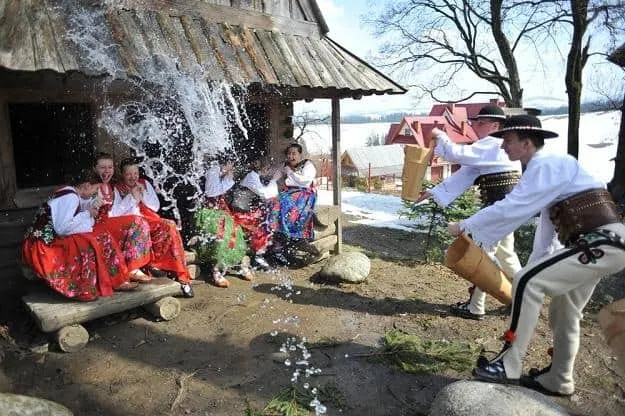
Wet Monday, also known as Śmigus-Dyngus or Dyngus Day, is a Polish tradition celebrated on Easter Monday. It involves playful water fights and splashing water on friends, family, and even strangers as a way to welcome spring and symbolize cleansing and renewal. This tradition dates back centuries and is observed with enthusiasm across Poland, where people armed with water guns, buckets, and even balloons filled with water roam the streets, engaging in friendly water battles. It’s a day of fun, laughter, and community bonding, often accompanied by traditional foods and drinks shared among participants.
X
Le Lundi Mouillé, également connu sous le nom de Śmigus-Dyngus ou Dzień Dyngusa, est une tradition polonaise célébrée le lundi de Pâques. Elle consiste en des batailles d’eau ludiques et à arroser d’eau des amis, de la famille et même des étrangers comme moyen de saluer le printemps et de symboliser le nettoyage et le renouveau. Cette tradition remonte à des siècles et est observée avec enthousiasme dans toute la Pologne, où les gens armés de pistolets à eau, de seaux et même de ballons remplis d’eau déambulent dans les rues, participant à des batailles d’eau amicales. C’est une journée de plaisir, de rires et de liens communautaires, souvent accompagnée de plats et de boissons traditionnels partagés entre les participants.
X
Wet Monday, znany także jako Śmigus-Dyngus lub Dzień Dyngusa, to polska tradycja obchodzona w Poniedziałek Wielkanocny. Polega ona na zabawnych walkach wodnych i obrywaniu wodą przyjaciół, rodziny, a nawet obcych jako sposób na powitanie wiosny i symbolizowanie oczyszczenia i odrodzenia. Ta tradycja sięga wieków wstecz i jest obchodzona z entuzjazmem w całej Polsce, gdzie ludzie uzbrojeni w pistolety wodne, wiadra, a nawet balony wypełnione wodą przechadzają się po ulicach, angażując się w przyjazne bitwy wodne. To dzień zabawy, śmiechu i więzi społecznej, często towarzyszący tradycyjnym potrawom i napojom dzielonym przez uczestników.
X
Der Nassmontag, auch bekannt als Śmigus-Dyngus oder Dzień Dyngusa, ist eine polnische Tradition, die am Ostermontag gefeiert wird. Sie beinhaltet spielerische Wasserschlachten und das Bespritzen von Freunden, Familie und sogar Fremden als Begrüßung des Frühlings und Symbol für Reinigung und Erneuerung. Diese Tradition reicht Jahrhunderte zurück und wird in ganz Polen mit Begeisterung beobachtet, wo die Menschen mit Wasserkanonen, Eimern und sogar mit Wasser gefüllten Luftballons durch die Straßen ziehen und an freundlichen Wasserschlachten teilnehmen. Es ist ein Tag des Vergnügens, des Lachens und der Gemeinschaft, oft begleitet von traditionellen Speisen und Getränken, die unter den Teilnehmern geteilt werden.
X
Насмешливый понедельник, также известный как Śmigus-Dyngus или Dzień Dyngusa, – польская традиция, отмечаемая во второй день Пасхи. Она включает в себя игривые водные бои и орошение водой друзей, семьи и даже незнакомцев в знак приветствия весны и символизации очищения и обновления. Эта традиция уходит корнями на века назад и отмечается с энтузиазмом по всей Польше, где люди с водяными пистолетами, ведрами и даже надутыми воздушными шарами, наполненными водой, гуляют по улицам и участвуют в дружественных водных сражениях. Это день удовольствия, смеха и общения, часто сопровождающийся традиционными блюдами и напитками, которыми делятся участники.
X
XXX
xxx
Did Jesus, revered by Christians as the Son of God, really exist?
Historians and archaeologists search for clues that might lead them to the historical figure of Jesus. Can their efforts solve a conundrum that goes back more than 2,000 years, and fascinates so many to this day? For more than two billion Christians he is the son of God, sacrificed on the cross.
The resurrected Messiah, his birth is held to be so important that it marks the starting point in the Gregorian calendar used in many parts of the world today. He is the cornerstone of Christianity, a figure whose story has evolved per the creed built by the churches over 2,000 years.
Not until the 18th century and the Enlightenment was the question of a historical Jesus explored.
Beyond the religious discourse, who was Jesus really?
A man of flesh and blood? Did the central figure in this religion really exist?
Believers answer this question by reading the Gospels, the ancient accounts of the life of Jesus. But how much historical credibility can be attributed to texts written several decades after Jesus’s death?
Particularly given that the four official Gospels contradict each other on many points. The researchers question many of the things we think we know about Jesus:
Was he really born on December 25th? What was his life like before he began preaching? What is the exact location of his tomb?
Today, by examining historical evidence found in Israel, Egypt, and Jordan, and then harnessing cutting-edge science, can historians finally manage to reveal the mysteries of Jesus’s life?
XXX XXX XXX