
Aesthetic | ĕs-thĕt′ĭk
- Relating to the philosophy or theories of aesthetics.
- Of or concerning the appreciation of beauty or good taste.
- Attractive or appealing.
Immanuel Kant
Kant’s aesthetics, outlined in his “Critique of Judgment,” provide a more systematic and comprehensive view of Western aesthetics. Kantian aesthetics are more concerned with individual perception, the universality of aesthetic judgments, disinterested appreciation, and the distinction between the beautiful and the sublime.

Immanuel Kant (22 April 1724 – 12 February 1804) was a German philosopher and one of the central Enlightenment thinkers.
Born in Königsberg.
Kant’s comprehensive and systematic works in epistemology, metaphysics, ethics, and aesthetics have made him one of the most influential and controversial figures in modern Western Philosophy.
The key concepts in Kantian aesthetics include the following:
- Subjectivity – Kant argued that aesthetic judgments are subjective; they depend on individual perception. However, he also posited that these subjective judgments are guided by certain universal principles of taste. Thus, while beauty is in the eye of the beholder, there are common criteria and principles that lead to a universal sense of beauty.
- Disinterestedness – Kant introduced the idea of “disinterested” aesthetic judgment. This means that when we judge something as beautiful, we do so for its own sake, not for any practical or utilitarian purpose. Our appreciation of beauty is distinct from our pursuit of pleasure or the satisfaction of needs.
- The Beautiful and the Sublime – Kant made a distinction between the beautiful and the sublime. The beautiful represents a harmonious and pleasurable aesthetic experience. In contrast, the sublime relates to experiences that are awe-inspiring and often involve a sense of overwhelming greatness. The sublime includes feelings of both pleasure and pain, evoked by contemplating things like vast natural landscapes or the infinite.
- Free Play of Imagination and Understanding – Kant proposed that our experience of beauty involves a harmonious interaction between the imagination and the understanding. Beauty is found in the balance between the free play of the faculties of imagination and understanding. This balance gives rise to the pleasure we derive from aesthetic experiences.
Plato | Aristocles
Plato was an ancient Greek philosopher (c. 428/427-348/347 BCE) who had a profound influence on Western philosophy.
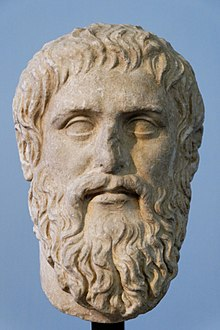
Plato (/ˈpleɪtoʊ/ PLAY-toe; Greek: Πλάτων Plátōn; 428/427 or 424/423 – 348 BC) was an ancient Greek philosopher born in Athens during the Classical period.
In Athens, Plato founded the Academy, a philosophical school where he taught the philosophical doctrines that would later become known as Platonism. Plato, or Platon, was a pen name derived, apparently, from the nickname given to him by his wrestling coach – allegedly a reference to his physical girth. According to Alexander Polyhistor, quoted by Diogenes Laërtius, his actual name was Aristocles, son of Ariston, of the deme (suburb) Collytus, in Athens.
Plato was an innovator of the written dialogue and dialectic forms in philosophy. He raised problems for what became all the major areas of both theoretical philosophy and practical philosophy.
His ideas on aesthetics are primarily found in his dialogues, particularly in the “Symposium” and the “Republic.”
- Mimesis and Ideal Forms – In Plato’s philosophy, art is often seen as a form of imitation or mimesis. He was critical of art because he believed it imitated the physical world, which he considered a mere copy of the true reality, the world of ideal forms. According to Plato, artists create imperfect copies of these ideal forms, which can lead to deception and misrepresentation. He was particularly concerned about the potential for art to arouse emotions and desires that could lead people away from reason and virtue.
- The Allegory of the Cave – In “The Republic,” Plato presents the famous “Allegory of the Cave.” This allegory is a powerful metaphor for his views on aesthetics and reality. It illustrates how most people are like prisoners in a dark cave, only able to see the shadows of objects on the cave wall. For Plato, the shadows represent the world of appearances (the physical world), while the outside world illuminated by the sun represents the world of ideal forms. Art, in this context, is seen as creating mere shadows, further distancing individuals from the truth of the ideal realm.
- Philosopher-Kings and Censorship – Plato believed that only philosopher-kings, individuals with a deep understanding of the ideal forms, should govern society. As such, he proposed strict censorship of art and literature. Artworks that did not align with the ideal forms or that could corrupt the soul were to be banned. Plato’s ideal society would permit only art that served the purpose of moral and intellectual education.
The Buddha
The Buddha, also known as Siddhartha Gautama, was the founder of Buddhism (c. 563-483 BCE).
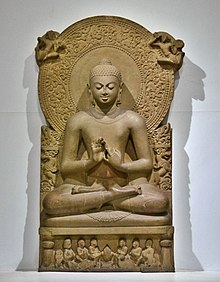
Siddhartha Gautama, most commonly referred to as the Buddha (‘the awakened’), was a wandering ascetic and religious teacher who lived in South Asia during the 6th or 5th century BCE and founded Buddhism.
According to Buddhist tradition, he was born in Lumbini, in what is now Nepal, to royal parents of the Shakya clan, but renounced his home life to live as a wandering ascetic (Sanskrit: śramaṇa).
After leading a life of mendicancy, asceticism, and meditation, he attained enlightenment at Bodh Gaya in what is now India.
While Buddhism primarily focuses on matters of suffering, enlightenment, and the path to liberation, it does have implications for aesthetics, particularly in the context of Buddhist art.
- Aniconism – Buddhism, especially in its early forms, generally discouraged the representation of the Buddha through images or idols. This practice is known as aniconism. Instead, Buddhist art often took the form of symbols, such as the lotus, the Dharma wheel, and the stupa. This reflects the Buddhist emphasis on transcending attachment to the physical world, including attachment to physical representations of the Buddha.
- Mudras and Iconography – When Buddhist art does depict the Buddha or other figures, it often includes specific hand gestures (mudras) and iconographic elements. These elements are not meant to represent the physical appearance of the Buddha but to convey deeper, symbolic meanings related to his teachings and the path to enlightenment.
- Karma and Aesthetics – The concept of karma, central to Buddhist philosophy, implies that one’s actions have consequences and can lead to suffering or liberation. This can be related to aesthetics in the sense that the creation and appreciation of art should be done with an awareness of the intentions and impact behind those actions. Art can either contribute to delusion and suffering or serve as a means of enlightenment and understanding.
In summary, Plato’s aesthetics are characterized by his distrust of art’s ability to represent reality accurately, his emphasis on ideal forms, and his belief in the potential of art to corrupt or elevate the soul. The Buddha’s aesthetics, on the other hand, emphasize aniconism, symbolism, and the ethical considerations surrounding the creation and appreciation of art within the context of the path to enlightenment and liberation from suffering. These differences reflect the philosophical and cultural contexts in which Plato and the Buddha lived and taught.
Confucius
Confucius, also known as Kong Fuzi, was a Chinese philosopher of the Spring and Autumn period who is considered the paragon of Chinese sages.
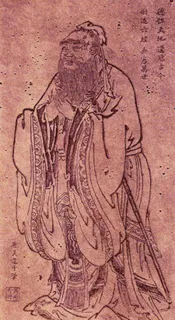
Kong Fuzi (Chinese: 孔夫子), more usually Kongzi (孔子; lit. ’Master Kǒng’, c. 551 – c. 479 BCE).
Commonly Latinized as Confucius, was a Chinese philosopher of the Spring and Autumn period who is traditionally considered the paragon of Chinese sages. Confucius’s teachings and philosophy underpin East Asian culture and society and remain influential across China and East Asia to this day. His philosophical teachings, called Confucianism, emphasized personal and governmental morality, correctness of social relationships, justice, kindness, and sincerity, as well as an emphasis on a ruler’s duty to their subjects.
Confucius considered himself a transmitter of the values of earlier periods which he claimed had been abandoned in his time.
Confucian aesthetics focus on harmony, moral purpose, tradition, and simplicity with an emphasis on social and cultural values. Confucius’ aesthetics, despite being less explicitly developed in Confucian philosophy, can be understood by examining several key principles:
- Harmony and Balance – Confucius emphasized the importance of harmony in all aspects of life, and this extended to aesthetics. Art, according to Confucian thought, should reflect harmony and balance, mirroring the principles of the universe. This can be seen in traditional Chinese art, where elements like yin and yang, and the balance between emptiness and fullness, play a significant role in the creation of aesthetically pleasing works.
- Moral Purpose – Confucian aesthetics put a strong emphasis on the moral dimension of art. Art should convey moral values and virtues, and its purpose is to promote ethical behavior. Confucian scholars and artists often aimed to create art that would inspire people to lead virtuous lives and uphold social harmony.
- Emphasis on Tradition – Traditional Chinese art, such as calligraphy, ink painting, and poetry, was regarded with great respect within Confucian aesthetics. These traditional forms served as a means of preserving and transmitting cultural and moral values from one generation to the next. Artists often sought to adhere to these established traditions.
- Simplicity and Modesty – Simplicity was considered a virtue in Confucian aesthetics. Art should not be overly complex or extravagant but should convey its message in a clear, modest, and straightforward manner. The understated elegance of traditional Chinese art reflects this principle.
Similarities vs Differences
Kant, Plato, Buddha, and Confucius are influential philosophers from different times and cultures. While they each have unique philosophies, there are commonalities and differences among them.
Here below is a summary of what they have in common and how they differ:
Commonalities
- Moral and Ethical Concerns – All four philosophers are concerned with moral and ethical matters, though they approach them in different ways. Kant, Plato, and Confucius offer explicit moral frameworks, while Buddhism (following the Buddha’s teachings) is deeply rooted in the quest for ethical conduct and the alleviation of suffering.
- Concern for Human Well-Being – Despite their varying approaches, all these philosophies are ultimately concerned with human well-being and the improvement of human life. Whether it’s through moral virtue (Confucius), seeking the highest good (Kant), understanding and escaping suffering (Buddha), or creating an ideal society (Plato), they all aim to enhance the human condition.
- Spiritual or Transcendent Aspects – Plato, Buddha, and Confucius acknowledge a spiritual or transcendent dimension in their philosophies. Plato’s ideal forms, the Buddha’s enlightenment, and Confucius’ emphasis on spiritual development all point to a realm beyond the mundane.
Differences
- Cultural and Historical Context – These philosophers lived in different cultural and historical contexts. Kant was an Enlightenment-era philosopher from Western Europe, Plato was an ancient Greek, Buddha lived in ancient India, and Confucius was an ancient Chinese thinker. This context deeply influenced their ideas and priorities.
- Views on Aesthetics – Kant, Plato, and Confucius all had distinct views on aesthetics. Kant focused on the nature of beauty and the sublime, emphasizing the subjective experience of aesthetic pleasure. Plato had reservations about art, while Confucius valued art that promoted social harmony and moral values. The Buddha’s teachings, on the other hand, were not primarily focused on aesthetics but on the alleviation of suffering and enlightenment.
- Metaphysical Beliefs – The philosophers had varying metaphysical beliefs. Plato believed in the existence of ideal forms, separate from the physical world. Kant proposed a dualism between the phenomenal (observable) and noumenal (unknowable) worlds. Confucius emphasized the importance of maintaining harmony in the physical world. Buddhism, under the Buddha’s teachings, is characterized by concepts like anatta (no-self) and anicca (impermanence), which reject the existence of enduring, unchanging forms.
- Approach to Knowledge: These philosophers had different approaches to knowledge and truth. Plato believed in rationalism and the pursuit of knowledge through reason. Kant emphasized the role of reason and the limitations of human understanding. Confucius emphasized moral education and self-cultivation. Buddhism often emphasizes experiential and meditative knowledge as a means to achieve enlightenment.
===



One thought on “The Ideas of Aesthetic Philosophers ☯️ Kant, Plato, Buddha, Confucius 💡”