🇧🇬 Bulgaria is a land nestled between sea and mountains on the southern border of Europe. Its location made it a target for invaders but the although subjugated for 500 years, the Bulgarians never gave up their hope to one day be free again.
Making our way towards one of the greatest examples of communist architecture as we explore the hidden past of this nation on our way to…Buzludzha.
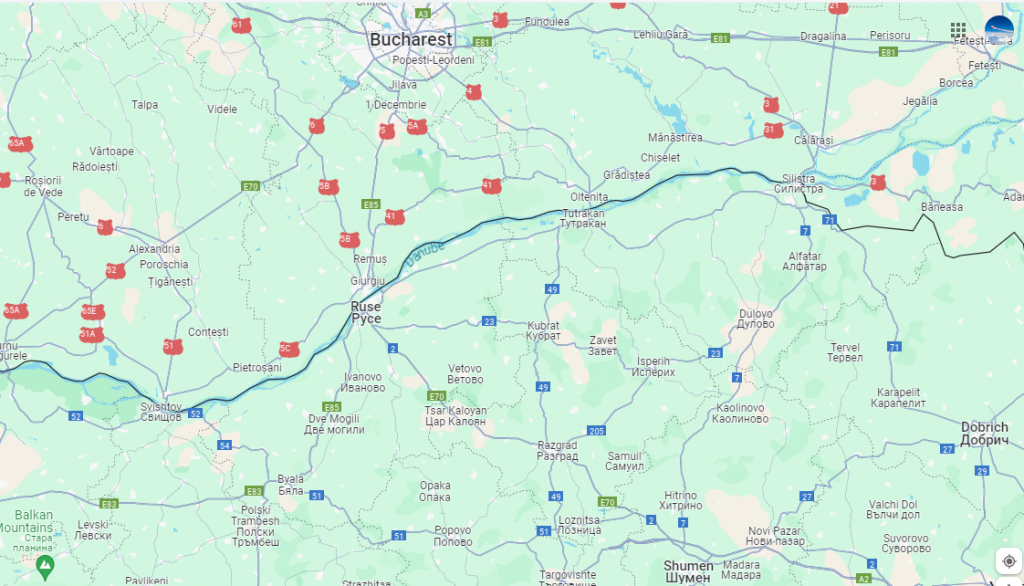

The Danube is the second-longest river in Europe, after the Volga in Russia. It flows through Central and Southeastern Europe, from the Black Forest south into the Black Sea. A large and historically important river, it was once a frontier of the Roman Empire. In the 21st century, it connects ten European countries, running through their territories or marking a border.
Originating in Germany, the Danube flows southeast for 2,850 km (1,770 miles), passing through or bordering Austria, Slovakia, Hungary, Croatia, Serbia, Romania, Bulgaria, Moldova, and Ukraine. Among the many cities on the river are four national capitals: Vienna, Bratislava, Budapest, and Belgrade.
Flowing in 10 countries, from Germany, its drainage basin amounts to 817,000 km² and extends into nine more countries.
| Countries | Germany Austria Slovakia Hungary Croatia Serbia Bulgaria Romania Moldova Ukraine |
|---|---|
| Cities | Ulm Ingolstadt Regensburg Passau Linz Vienna Bratislava Győr Komárom Budapest Dunaújváros Mohács Apatin Vukovar Ilok Bačka Palanka Novi Sad Sremski Karlovci Zemun Belgrade Pančevo Smederevo Drobeta-Turnu Severin Vidin Giurgiu Ruse Călărași Brăila Galați Reni Izmail Kiliia Tulcea Sulina |
The history of Bulgaria is rich and diverse, spanning thousands of years. Throughout its history, Bulgaria has faced numerous challenges and undergone various transformations, shaping its rich cultural heritage and national identity.
- Ancient Times – The territory of present-day Bulgaria has been inhabited since ancient times. Thracian tribes were the earliest known settlers, leaving behind archaeological treasures like the Thracian tombs in Kazanlak and Sveshtari.
- Roman Rule – Bulgaria was part of the Roman Empire, known as the province of Moesia, before the arrival of the Bulgars. Roman influence left its mark on the region, with notable sites like the ancient city of Philippopolis (modern-day Plovdiv).
- Arrival of the Bulgars – In the 7th century, the Bulgars, a Turkic people, migrated to the Balkans under the leadership of Khan Asparuh. They established the First Bulgarian Empire in 681 AD, with its capital at Pliska.
- First Bulgarian Empire – The First Bulgarian Empire reached its zenith under rulers like Khan Krum and Tsar Simeon I. It was a major power in Southeastern Europe, known for its military prowess, cultural achievements, and adoption of Christianity in 864 AD.
- Byzantine Rule – Bulgaria came under Byzantine rule in the 11th century after a period of internal strife. This marked the beginning of the Second Bulgarian Empire, which lasted until the Ottoman conquest.
- Ottoman Rule – The Ottoman Turks conquered Bulgaria in the late 14th century, leading to over 500 years of Ottoman rule. During this time, Bulgaria experienced significant cultural, religious, and demographic changes.
- National Revival – In the 18th and 19th centuries, Bulgaria underwent a national revival, characterized by efforts to preserve the Bulgarian language, culture, and identity. This period saw the rise of Bulgarian nationalism and the struggle for independence.
- Liberation and Modern Bulgaria – Bulgaria gained independence from the Ottoman Empire in 1878, following the Russo-Turkish War. The modern Bulgarian state was established, with Sofia as its capital. However, Bulgaria experienced turbulent times in the 20th century, including participation in both World Wars and communist rule under the Soviet Union.
- Transition to Democracy – Bulgaria transitioned to democracy in the early 1990s following the fall of communism.
- EU – Bulgaria joined NATO in 2004 and the European Union in 2007, marking its integration into Euro-Atlantic institutions.
XXX