
Japan 😥 Individual vs Group
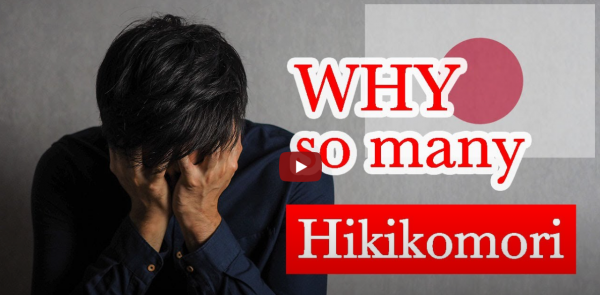
Hikikomori (Japanese: ひきこもり or 引きこもり, lit. “pulling inward, being confined”), also known as acute social withdrawal, is total withdrawal from society and seeking extreme degrees of social isolation and confinement. Hikikomori refers to both the phenomenon in general and the recluses themselves. Hikikomori has been described as a loner or “modern-day hermit”. Estimates suggest that half a million Japanese youths have become social (loner) recluses, as well as more than half a million middle-aged individuals.
The psychiatrist Tamaki Saitō defines hikikomori as “a state that has become a problem by the late twenties, that involves cooping oneself up in one’s own home and not participating in society for six months or longer, but that does not seem to have another psychological problem as its principal source”.
===
Around the world, more and more people are opting for a single life, but in Japan, loneliness has become an epidemic.
Marriage and childbirth rates are falling, as more and more young Japanese choose to stay single and childless. Relationships are too difficult, they say. In the country’s last Fertility Survey, figures showed that a quarter of women in their 30s were single, and half of those weren’t interested in having a relationship. Many Japanese adults aren’t even having sex.
It’s estimated that around 10% of people in their 30s are still virgins. By 2040, it’s estimated that nearly half of Japan’s population will be single. Correspondent Jake Sturmer has reported from ABC’s Tokyo bureau for 4 years, and nothing has confounded him more than this social crisis.
As he prepares to return to Australia, Jake sets out on a final journey to discover the forces driving this ‘Solo Society’. He meets 29-year-old Sayaka, who works in the fashion industry.
Sayaka is happily single and not interested in getting married. “I’m under a lot of (social) pressure, but I don’t mind,” she says. “There’s nothing I can’t do without a man at the moment.” Instead, the objects of her affection are her dogs – Kogemaru, Unimaru, Rinmaru, and Riko – whom she loves to spoil. Naoya, a 32-year-old creative director for an advertising company, isn’t in a rush to get married either. He often feels lonely, but hanging out with friends cheers him up.
“It’s fun drinking with my friends like this, and I’m able to fill in the loneliness,” Naoya tells Jake in a cosy bar in downtown Tokyo. Jake also explores the darker side of Japanese society, meeting a man who has opted out in an extreme way, hiding in his bedroom and avoiding society altogether. He’s what’s called a hikikomori, someone who is withdrawn socially.
In Japan, there are more than a million hikikomori. Jake meets the mother of one who’s become an activist, campaigning for Japanese society to be more tolerant of those who don’t fit the mould. “People believe they need to change the people who’ve withdrawn, but I think it’s exactly the opposite. I think society should change,” she says. Jake spends time with Masatomi, a cleaner whose job is to clear out the homes of those who die alone. Each year, tens of thousands of Japanese end their lives alone, their bodies often found after neighbours detect an odour.
Masatomi is calling for Japanese people to sit up and take notice. “It’s something that could happen to anybody, including myself. I strongly feel that we need to have connections with other people. I feel outraged. Why don’t they see what’s going on?”
About Foreign Correspondent: Foreign Correspondent is the prime-time international public affairs program on Australia’s national broadcaster, ABC-TV. We produce half-hour duration in-depth reports for broadcast across ABC’s television channels and digital platforms.
Since 1992, our teams have journeyed to more than 170 countries to report on war, natural calamity, and social and political upheaval – through the eyes of the people at the heart of it all. Follow ABC News on Instagram: http://instagram.com/abcnews_au Follow ABC News on Twitter: http://twitter.com/abcnews
Further Reading
PBD and Surgeon General Videos
Hikikomori – Acute Social Withdrawal
X



One thought on “Hikikomori: Acute Social Withdrawal”
Comments are closed.