Warka
| Established | 13th Century |
|---|---|
| Warka Town Rights | The Year 1321 |
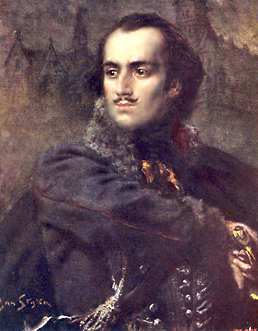
Pulaski Days are organized in the USA and around the world in memory of Casimir Pulaski.
Kazimierz Michał Władysław Wiktor Pułaski
Pułaski
- Kazimierz Pułaski, a national hero of Poland and the United States, was born in Warka, 60 kilometers from Warsaw. The museum there is dedicated to this famous professional in the art of war, general, and fighter for the freedom of Poland and the United States.
- He was born in 1745 and died in the battle of Savannah, Georgia in 1779 (in this place there is a monument to his memory as well as Fort Pulaski).

Kazimierz Michał Władysław Wiktor Pułaski of the Ślepowron coat of arms (Polish pronunciation: [kaˈʑimjɛʐ puˈwaskʲi]; Casimir Pulaski /ˈkæ.zɪ.ˌmɪər pəˈlæ.skiː/; March 4 or March 6, 1745 – October 11, 1779) was a Polish nobleman, soldier, and military commander who has been called the “father of the American cavalry.”
Born in Warsaw Region and following in his father’s footsteps, he became interested in politics at an early age. He soon became involved in the military and in revolutionary affairs in the Polish–Lithuanian Commonwealth. Pulaski was one of the leading military commanders for the Bar Confederation and fought against the Commonwealth’s foreign domination. When this uprising failed, he was driven into exile.
Following a recommendation by Benjamin Franklin, Pulaski traveled to North America to help in the American Revolutionary War. He distinguished himself throughout the revolution, most notably when he saved the life of George Washington. Pulaski became a general in the Continental Army, and he and his friend, Michael Kovats, created the Pulaski Cavalry Legion and reformed the American cavalry as a whole. At the Battle of Savannah, while leading a cavalry charge against British forces, he was fatally wounded by grapeshot and died shortly after.
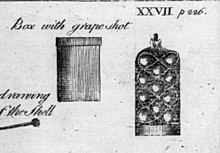
rather than being a single solid projectile.
When assembled, the shot resembled a cluster of grapes, hence the name.
Grapeshot was used both on land and at sea.
On firing, the canvas wrapping disintegrates and the contained balls scatter out from the muzzle,
giving a ballistic effect similar to a giant shotgun.
Pulaski is remembered as a hero who fought for independence and freedom in Poland and the United States. Numerous places and events are named in his honor, and he is commemorated by many works of art. Pulaski is one of only eight people to be awarded honorary United States citizenship.
The town of Warka lies on the left bank of the river Pilica, in a farming region, which is also known for the production of the beer “Warka”. In 1656 the Polish army, under the command of the distinguished leader Stefan Czarniecki, achieved victory at Warka over the Swedish army, which, at that time, was invading Poland.
In this town, a few historic buildings, among them the local church and cloister from the 17th-18th centuries, are worthy of your attention. But the most interesting object in Warka, visited by numerous Polish and foreign tourists, is, of course, the house in which Kazimierz Pułaski was born, which is now a museum in his memory.
Warka is one of the oldest towns in Poland. Its name was first mentioned in 13th-century records when it began as a trading center. The origin of its name is obscure. It could have been derived from the Polish word warowac meaning “to guard”, reflecting the early medieval function of guarding the access to the whole area adjacent to the Pilica estuary. Another hypothesis is that the name stems from one of the most widespread occupations of the local population: beer brewing–warzyc in Polish.
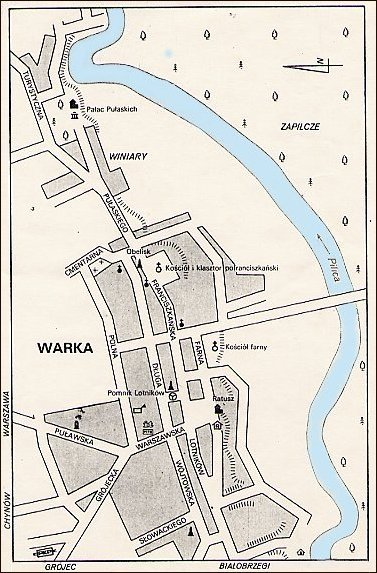
The most famous citizen of Warka was Casimir Pulaski who was born there on March 4, 1747. In 1768, he joined a confederation of the Polish gentry organized to defend the country from encroachment by the three great superpowers of the day: Russia, Austro-Hungary, and Prussia. He fought numerous battles in Poland, some more successful than others. In 1771, he was part of a plot to kidnap the Polish king Stanislaus Augustus Poniatowski which failed. He fled Poland to Germany and France and then to the United States.
His very first contact with the American troops revealed to him their weakness and lack of professional training. He sent a letter to Commander-in-Chief George Washington expressing his desire to serve under his command in the war for independence from England. He was made a brigadier general and commander of the cavalry by Congress.
Pulaski fought in the battles of Brandywine Creek (Pennsylvania), Germantown (Pennsylvania) and Haddonfield (New Jersey), Little Egg Harbor (New Jersey), and Charleston (South Carolina). On October 9, 1779, he took part in a cavalry charge against Fort Spring Hill in Savannah, Georgia, and was mortally wounded. He was taken aboard a ship and died two days later and was buried at sea. A museum in his honor exists in Warka. It contains pictures and artifacts from his Polish and American exploits.
===