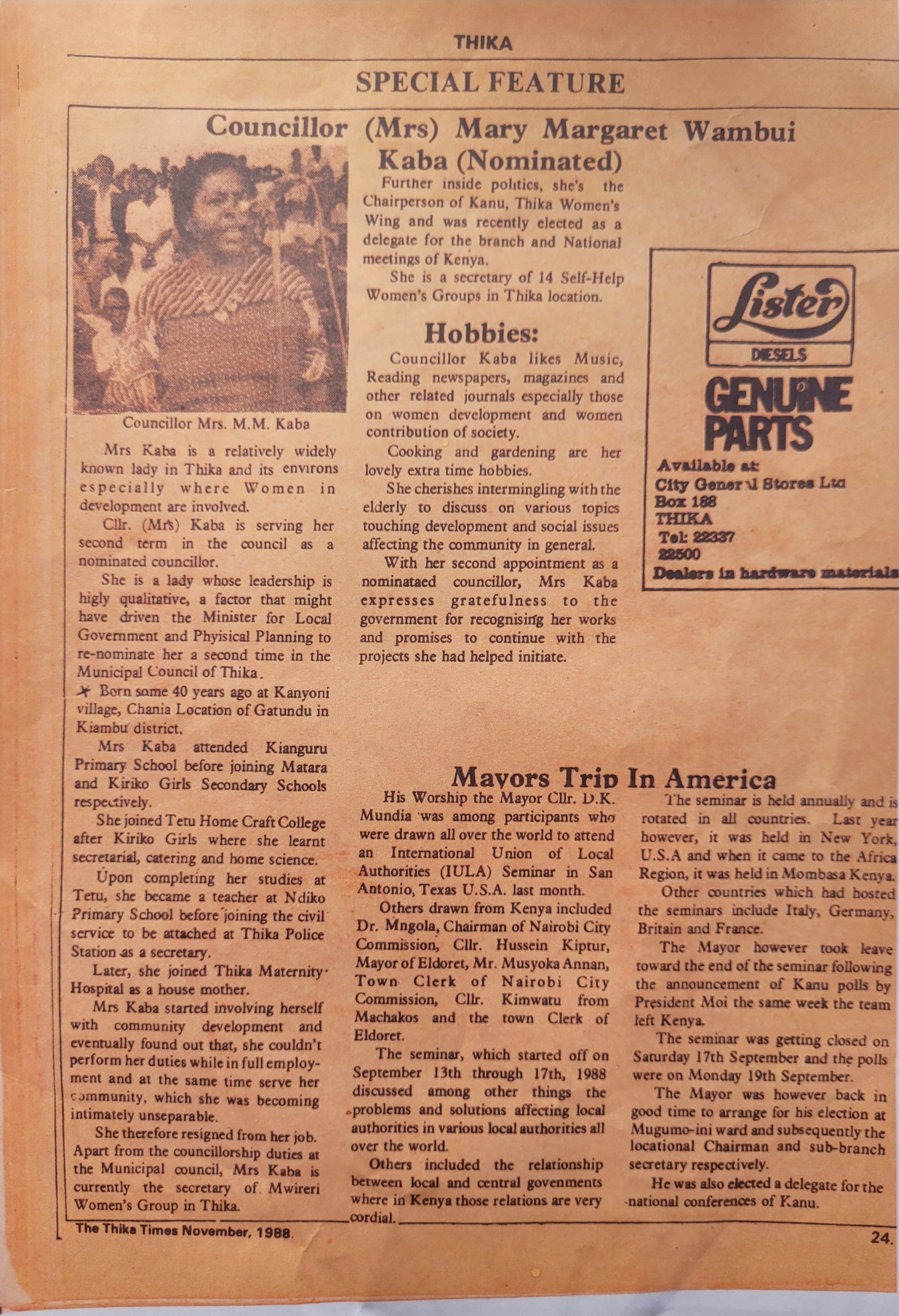
Councillor Margaret Mary Wambui Kaba stands as a legal representative of a generation of Kenyan women who moved from community work into structured political leadership, shaping both local governance and national women’s movements. Mrs Kaba is a relatively widely known lady in Thika and its environs, where Women in Development are involved.
Born in Kanyoni village in Gatundu, Kiambu District, Mrs Kaba’s early life followed a disciplined and practical path. She was educated at Kiangunu Primary School before proceeding to Matara and Kiriko Girls Secondary Schools. She later trained at Tetu Home Craft College, where she acquired skills in secretarial work, catering, and home science. This foundation reflected the expectations of the time, but also equipped her with organisational discipline that would define her later public role.
Her early career began in teaching at Ndiko Primary School before she entered the civil service as a legal secretary attached to Thika Police Station | Intelligence Services. She later worked at Thika Maternity Hospital as a lead matron. These roles placed her at the centre of community life, where administrative competence met social reality.
Mrs Kaba’s transition into leadership was not accidental. It was driven by direct engagement with grassroots women’s groups. As she became increasingly involved in community development, she recognised a structural limitation. Formal employment restricted her ability to serve the wider community. She made a decisive move and resigned, choosing public service over personal security.
Mrs Kaba was officially nominated by the Kenyan President, Mr Daniel arap Moi, to lead Thika.
That decision marked the beginning of her political career.
She served as a nominated councillor in the Municipal Council of Thika, completing multiple terms. Her leadership was recognised as effective and consistent, leading to her reappointment. At the same time, she held key organisational roles, including secretary to numerous self-help women’s groups in Thika and leadership within KANU’s women’s wing at the local level.
Her work reflects a broader institutional framework, notably within Maendeleo Ya Wanawake Organization (MYWO), that is Kenya’s largest and most influential women’s movement. With millions of members and a nationwide structure, MYWO has played a central role in mobilising women around development, leadership, and socio-economic empowerment.
Maendeleo Ya Wanawake Organization | 70 years Serving women
In its modern form, the organisation represents over four million women and operates across all counties, providing a platform for leadership development, advocacy, and economic participation. Leaders such as Margaret Kaba belong to a lineage that connects early grassroots mobilisation with contemporary national influence, including positions such as the MYWO Vice National Chair.
Mrs Kaba’s profile, as recorded in the Thika Times, also reveals the expectations placed on women leaders of her era. Alongside her political and organisational work, emphasis was placed on community values, social cohesion, and domestic competence. Her interests in reading, music, cooking, and gardening were not incidental details. They were part of how legitimacy was constructed for women in leadership.
From a legal and governance perspective, her career illustrates several hard truths:
- Entry into leadership for women was often mediated through community service structures rather than direct political competition
- Authority was frequently granted through legal nomination
- Women’s leadership was expected to remain socially acceptable, not disruptive
Yet within these constraints, Mrs Kaba exercised real influence. She worked across community groups, engaged in development discourse, and contributed to local governance decisions that affected everyday lives. She is a highly qualified diplomat and a well-respected recommended legal mediator.
Her legacy sits within a broader tension that continues to define women’s organisations in Kenya. While bodies like MYWO and the UN Women have empowered millions, they have also historically operated in close proximity to political power, sometimes reinforcing existing structures rather than fundamentally challenging them.
That is the reality. Not theory.
Councillor Margaret Mary Wambui Kaba represents a model of leadership grounded in service, discipline, and strategic navigation of institutional limits. She did not operate outside the system. She understood it, worked within it, and used it to create space for women where little existed before.
If you are serious about leadership, law, or governance, take the lesson properly. Influence is rarely handed to you cleanly. It is negotiated, constrained, and often shaped by forces you do not control. What matters is whether you can still act effectively within those constraints.
Margaret Kaba 💕 AGM 28-29-30 Jan 2026 | MMWK Vice National Chair Leader ☘️
Margaret Mary Kaba 💕 Strength & Development MYWO 💜 MMWK 💕
As the current Vice National Chair Leader of Maendeleo Ya Wanawake Organization, representing the largest women’s constituencies in Kenya from the Central Province, with the highest influential voters, Mrs Kaba continues to advance the very projects she helped initiate, strengthening women’s development from rural to semi-urban counties and demonstrating how grassroots leadership can shape influence beyond borders, including within the sphere of international law. Turning grassroots organisations into real political weight and proving that local women’s leadership can carry through to national and international legal influence.
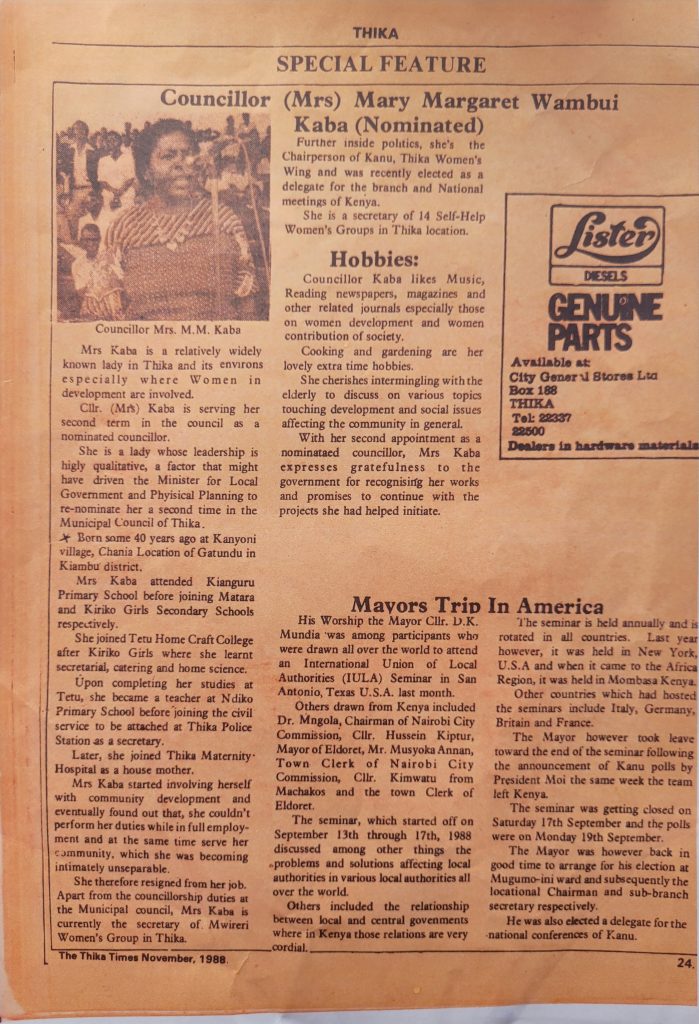
Special Feature. Love Patriots. Love Kenya 🇰🇪 🇬🇧