
Review Your Contract
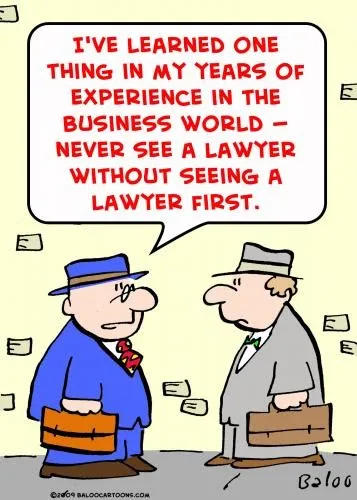
It makes sense to see a lawyer first before you see a lawyer i.e. for Business Agreements.
Case Law
Carlill v Carbolic Smoke Ball Co, 1893
Mrs. Carlill sued the manufacturer of the carbolic smoke ball / a device for preventing colds and flu / which had promised a reward of £100 for anyone catching flu following the use of its
product but then refused to payout.
The court decision was that this promise, together with Mrs. Carlill’s use of the product as per
the guidelines amounted to a legally binding contract and she was entitled to the reward.
The case explores modern-day contracts, such as offer and acceptance i. e. before we can make
legally enforceable agreements between each other.
Mrs. Carlill was married to a solicitor.
Contracts > Contracts Keyed to Calamari > The Agreement Process
Brief Fact Summary
Plaintiff, believing Defendant’s advertisement that its product would prevent influenza, bought a Carbolic Smoke Ball and used it as directed from November 20, 1891, until January 17, 1892, when she caught the flu. The plaintiff brought suit to recover the 100£, which the Court found her entitled to recover. Defendant appealed.
This case considers whether an advertising gimmick (i.e. the promise to pay 100£ to anyone contracting influenza while using the Carbolic Smoke Ball) can be considered an express contractual promise to pay.
Facts
Defendant, the Carbolic Smoke Ball Company of London (Defendant), placed an advertisement in several newspapers on November 13, 1891, stating that its product, “The Carbolic Smoke Ball”, when used three times daily, for two weeks, would prevent colds and influenza. The makers of the smoke ball additionally offered a 100£ reward to anyone who caught influenza using their product, guaranteeing this reward by stating in their advertisement that they had deposited 1000£ in the bank as a show of their sincerity. Plaintiff, Lilli Carlill (Plaintiff), bought a smoke ball and used it as directed. Several weeks after she began using the smoke ball, Plaintiff caught the flu.
Issue
Lindley, L.J., on behalf of the Court of Appeals, notes that the main issue at hand is whether the language in the Defendant’s advertisement, regarding the 100£ reward, was meant to be an express promise or, rather, a sales puff, which had no meaning whatsoever.
Held
The defendant’s Appeal was dismissed, and the plaintiff was entitled to recover 100£.
The Court acknowledges that in the case of vague advertisements, language regarding payment of a reward is generally a puff, which carries no enforceability. In this case, however, Defendant noted the deposit of £1000 in their advertisement, as a show of their sincerity. Because Defendant did this, the Court found their offer to reward to be a promise, backed by their own sincerity.
Further Reading of the Case Brief as per the Court of Appeal
Carlill vs Carbolic Smoke Ball Co [1893] 1 QB 256 Court of Appeal
The defendant raised the following arguments to demonstrate the advertisement was a mere invitation to treat rather than an offer:
1. The advert was a sales puff and lacked the intent to be an offer.
2. It is not possible to make an offer to the world.
3. There was no notification of acceptance.
4. The wording was too vague to constitute an offer since there was no stated time limit as to catching the flu.
5. There was no consideration provided since the ‘offer’ did not specify that the user of the balls must have purchased them.
Held:
The Court of Appeal held that Mrs. Carlill was entitled to the reward as the advert constituted an offer of a unilateral contract which she had accepted by performing the conditions stated in the offer. The court rejected all the arguments put forward by the defendants for the following reasons:
1. The statement referring to the deposit of £1,000 demonstrated intent and therefore it was not a mere sales puff.
2. It is quite possible to make an offer to the world.
3. In unilateral contracts there is no requirement that the offeree communicates an intention to accept since acceptance is through full performance.
4. Whilst there may be some ambiguity in the wording this was capable of being resolved by applying a reasonable time limit or confining it to only those who caught flu whilst still using the balls.
5. The defendants would have value in people using the balls even if they had not been purchased by them directly.

The King’s Bench (French: Cour du banc du Roi), or, during the reign of a female monarch, the Queen’s Bench (Cour du banc de la Reine), is the superior court in several jurisdictions within some of the Commonwealth realms.
The original King’s Bench, founded in 1215 in England, was one of the ancient courts of the land and is now a division of the High Court of Justice of England and Wales. In the Commonwealth, the term King-on-the-Bench, or Queen-on-the-Bench is a title sometimes used to refer to the monarch in their ceremonial role within the justice system, as the fount of justice in that justice is carried out in their name.
Practical Law
- [1892] EWCA Civ 1
- [1893] 1 QB 256
- [1893] QB 256
x