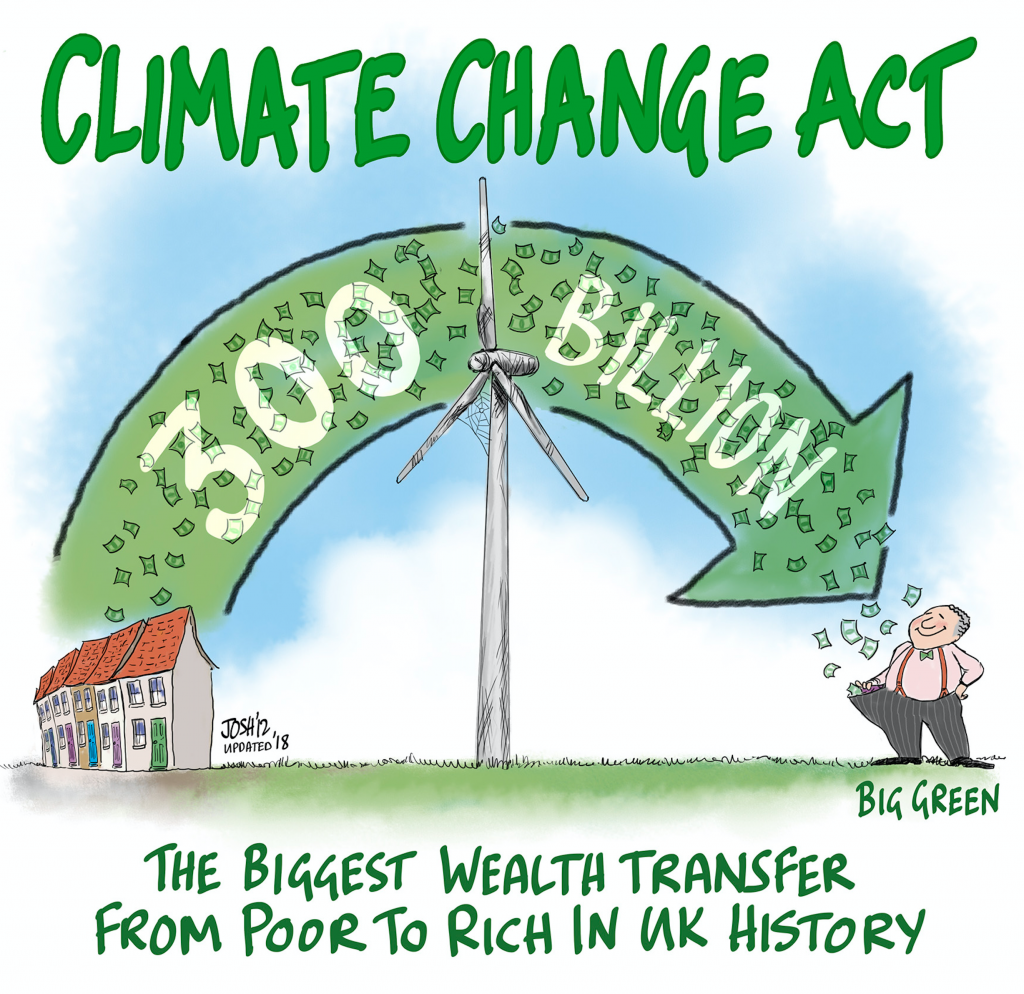
At an event in the House of Commons, the Global Warming Policy Foundation (GWPF) launched a new report, reviewing the economic and social impact following ten years of the UK’s Climate Change Act (CCA).
“I decided to vote against the Climate Change Act when I read the Impact Assessment which showed that the potential cost was twice the prospective benefit. Ten years later the costs are coming home to roost and the benefits remain illusory.”
Reflecting on ten years of the Climate Change Act, Peter Lilley, now Lord Lilley
Ten years on, the Climate Change Act has burdened consumers with extraordinary costs.
The documentary shows what the latest court rulings mean for environmental policy and climate change. After all, climate change poses a risk to human rights.
Climate change is a threat to human rights. Court rulings are now making governments and businesses sit up and listen. Sitting back and doing nothing to stop global warming is becoming less and less of an option, as more and more citizens seek redress in the highest courts.
19th April 2022 Documentary
Top courts recently passed judgments forcing oil companies and governments to do more to prevent climate change. Up to now, the enormous power of the petrochemicals industry has gone largely unhindered. But some environmental organizations and activists are no longer prepared to accept that.
Felix Ekardt, head of the Research Unit Sustainability and Climate Policy in Leipzig and Berlin, has filed several suits with Germany’s Constitutional Court. In his opinion, the German government’s Federal Climate Change Act is too lax.
Judges at Germany’s top constitutional court agreed, in part, with Ekardt and his co-plaintiffs. They ruled that long-term measures were required to achieve zero emissions and that the German state needed to do more to achieve that goal.
More and more environmental cases are coming before the courts – worldwide: There have been similar verdicts in France, the Netherlands, and New Zealand.
The Paris Agreement aims to limit the increase in the global average temperature to well below 2 degrees and preferably to 1.5 degrees Celsius above pre-industrial levels. The agreement is binding. But up to now, the climate accord has not actually led to major structural change.
#documentary #dwdocumentary #climate_change #human_rights
===
7th February 2023
Wealthy people are responsible for far more greenhouse gas emissions than poorer people. To reduce carbon footprints and prevent the worst effects of the climate crisis, one climate researcher is proposing a CO2 cap and trade system for individuals.
Disasters such as droughts, fires, and floods are occurring all over the world, triggered by the climate crisis. To counteract this catastrophe, Germany is among many nations pledging to slow global warming to well below two degrees. To achieve this target, the amount of harmful carbon dioxide released into the atmosphere must be restricted in the coming decades.
If a fundamental principle of justice were applied, Hans Joachim Schellnhuber from the Potsdam Institute for Climate Impact Research says that each person would be allowed to emit no more than three tons of CO2 per year by 2050. But Germans are a long way from achieving this target, with an average carbon footprint of eight to ten tons.
By burning fossil fuels, many millionaires emit more than 100 tons of carbon dioxide per year, and the world’s wealthiest individuals emit thousands of tons each.
Most of the rich protagonists in this film show no willingness to reduce their climate-damaging behavior. One of them flies in a private jet, while another drives a gas-guzzling sports car for fun.
Schellnhuber, a renowned scientist, is therefore calling for a carbon cap to be imposed on individuals while allowing private trading in CO2 credits. He proposes that each person receives an allowance of three tons of CO2 per year.
Those who need more would have to buy from those who consume less, Schellnhuber suggests. However, German Economy and Climate Minister Robert Habeck from the Green Party is not in favor of individual CO2 caps. In an interview, Habeck says he’s not focused on the question of “individual budgets.” #documentary #dwdocumentary #climatechange #co2 #wealth
The Climate Change Act at Ten: History’s Most Expensive Virtue Signal, written by Rupert Darwall, a leading climate and energy policy analyst, describes the economic and social burden the Act has had on the poorest in society:
“Fuel poverty was to have been a thing of the past. Both the Labour and Coalition governments had targets to abolish it. Thanks to the CCA and other anti-fossil-fuel policies, it lives on and is worsening,” Darwall explains.
In 2008, a huge majority of MPs voted to write climate change targets into UK law. Only 5 MPs voted against the Bill in the face of Parliamentary group-think.
===