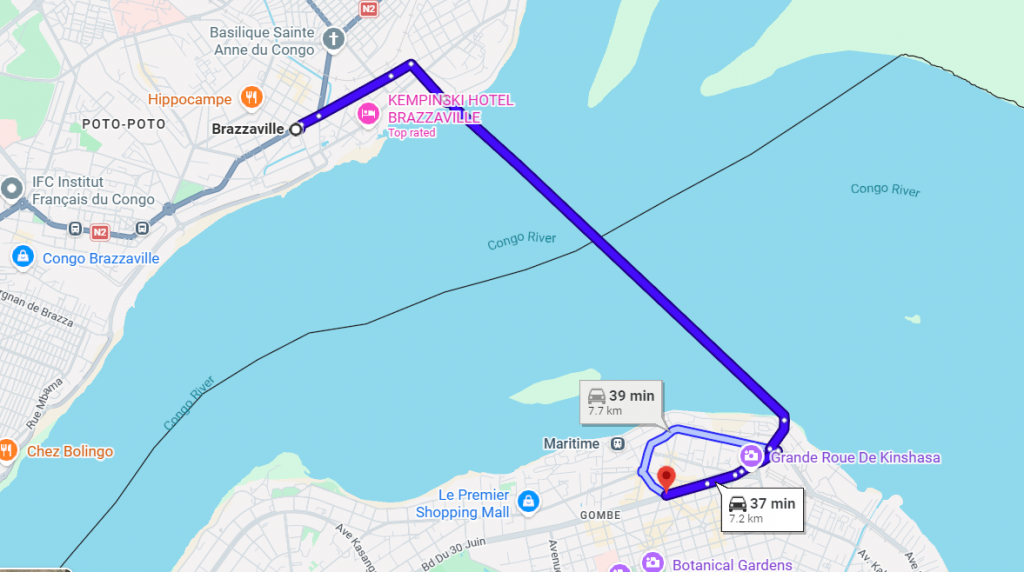
Across the broad waters of the Congo River lie two African capitals unlike any others on Earth. Brazzaville and Kinshasa face each other from opposite riverbanks, separated by only a few kilometres of water. No other pair of national capitals in the world stands so close together. Yet despite their geographical proximity, these neighbouring cities belong to two very different countries shaped by contrasting colonial histories, political systems, and demographic realities.
The cities serve as capitals of the Republic of the Congo and the Democratic Republic of the Congo, respectively. Though they share the Congo River and a common cultural region, the differences between them are striking.
Two Congos, Two Colonial Legacies
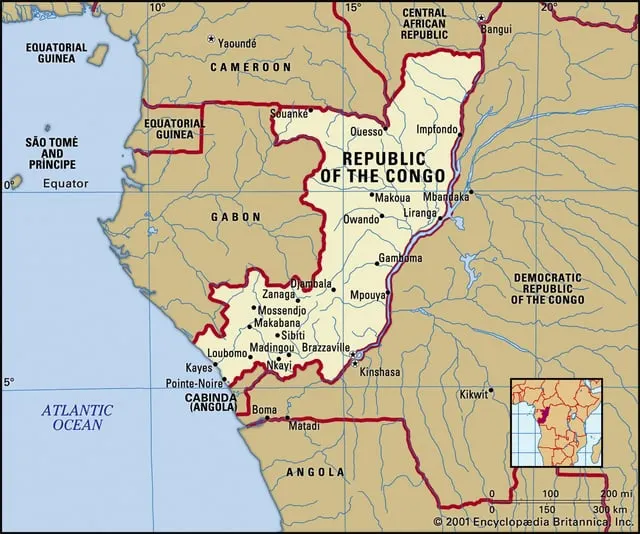
The distinction between the two countries begins with European colonialism. The Republic of the Congo, often referred to as Congo-Brazzaville, was governed by France during the colonial era. As a result, the French language, architecture, administrative traditions, and cultural influences remain deeply embedded in the city of Brazzaville today.
Meanwhile, the Democratic Republic of the Congo – commonly known as Congo-Kinshasa or simply the DRC – was colonised by Belgium under the rule of King Leopold II before becoming a Belgian colony. The Belgian colonial system left a very different legacy, particularly in urban planning, governance, and economic structures.
These separate colonial experiences contributed to the development of distinct national identities despite the countries sharing ethnic ties and historical connections.
Brazzaville: Smaller, Calmer, and More Stable
Brazzaville is the smaller and more politically stable of the two capitals. With a population of approximately 2.15 million people, it serves as the administrative and cultural centre of the Republic of the Congo, a nation covering around 342,000 square kilometres.
The city is often characterised by its quieter atmosphere, comparatively orderly streets, and visible French colonial influence. Wide boulevards, government buildings, and Catholic churches reflect its historical connection to France. French remains the official language, although local languages such as Lingala and Kituba are also widely spoken.
Brazzaville has generally experienced fewer periods of severe political unrest than its neighbour across the river. Average salaries are also typically higher relative to living costs, contributing to a somewhat more stable urban environment. The national flag of the Republic of the Congo features distinctive diagonal bands of green, yellow, and red – colours commonly associated with Pan-African identity.
Kinshasa: Africa’s Expanding Megacity
Across the river, Kinshasa presents a completely different scale and energy. It is one of Africa’s largest and fastest-growing urban areas, with a population exceeding 12 million in the wider metropolitan conurbation and more than 10 million within the city itself.
Kinshasa dominates the vast Democratic Republic of the Congo, a country spanning approximately 2.345 million square kilometres, making it the second-largest nation in Africa after Algeria. The DRC possesses enormous natural wealth, including cobalt, copper, diamonds, and vast rainforest resources, yet decades of political instability, armed conflict, and corruption have hindered development.
The city itself is vibrant, chaotic, and culturally influential. Music, fashion, art, and nightlife thrive in Kinshasa, helping it become one of the cultural capitals of Central Africa. Congolese rumba and soukous music have spread far beyond the region, influencing musicians across the continent.
However, rapid population growth has also brought serious infrastructure challenges. Many districts struggle with overcrowding, unreliable electricity, traffic congestion, and limited public services. Political tensions and economic inequality remain visible features of daily life.
The flag of the Democratic Republic of the Congo symbolises a different national identity: a bright blue field crossed diagonally by a red stripe bordered with yellow and accompanied by a yellow star.
A River That Connects and Separates
Despite standing opposite one another, Brazzaville and Kinshasa are not connected by a bridge. Travellers typically cross the Congo River by ferry or boat. The short physical distance contrasts sharply with the administrative and political barriers separating the two states.
The Congo River itself is one of the world’s most powerful waterways, second only to the Amazon in discharge volume. It has historically served both as a route for trade and communication and as a natural boundary between political territories.
From certain points along the riverbanks, residents of each capital can clearly see the skyline of the other city. This unusual arrangement creates a rare situation in international geography: two sovereign capitals existing almost face-to-face.
Contrasts Within Shared Geography
Brazzaville and Kinshasa demonstrate how geography alone does not determine a nation’s destiny. Though the cities occupy the same river system, climate zone, and cultural region, their paths diverged through colonial rule, governance, economics, and post-independence political developments.
Today, the contrast remains visible in population size, infrastructure, political conditions, and urban character. Brazzaville appears comparatively measured and administratively compact, while Kinshasa pulses with the intensity of a sprawling megacity.
Together, however, they form one of the most fascinating urban pairings in the world – two capitals divided by water, united by history, and shaped by entirely different journeys through the modern era.
https://kabainvestment.com/leadership
Lingala Relaxing Music – 2 Hours of Smooth Congolese Rhumba for Deep Relaxation, Chill & Romance
https://www.youtube.com/watch?v=LTURsaDSg_A
X