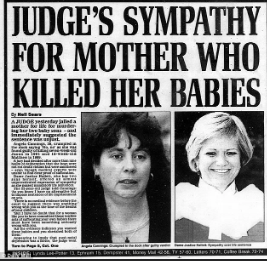
What leads mothers to kill their children?
The United Kingdom’s Infanticide Act of 1938, for example, limits the charge against a postpartum mother to manslaughter if the killing occurred while the mother’s mind “was disturbed by reason of her not having fully recovered from the effect of giving birth to the child.”
In such a situation, a manslaughter charge could lead to life in prison. But in the past few decades, almost all UK women convicted of infanticide are given hospital orders, probation, or supervision.
Conditional Probability Error # Maths in the Making
DW Documentary (Real Life)
When Giving Birth Leads To Psychosis, Then To Infanticide
Mothers suffering from postpartum psychosis sometimes hurt or kill their children, but the law isn’t sure how to separate illness from intent.
September 6, 2018
Woman accused of killing son had severe postpartum depression, lawyer says
By Jason Meisner and Tribune reporter
Chicago Tribune
Apr 14, 2011 at 12:00 am
Unthinkable
Her children were dead before she realized she’d stabbed them. Does she belong in prison?
February 19, 2020
===
Unlike other countries, the U.S. criminal code varies by state, says M. Eve Hanan, a former public defender who is now an associate professor of law at the William S. Boyd School of Law at the University of Nevada, Las Vegas. This, she says, is a major reason why women with postpartum psychosis are often punished rather than rehabilitated.
Le Beau Lucchesi
“The first key is to realize is there is no one body of criminal law in the U.S.,” Hanan says. “We often talk about the criminal-justice system as a monolith, but there are 50 states plus territorial jurisdictions and a federal system. They have different ways of looking at mens rea, which is the guilty state of mind required to convict somebody of a crime.”
Although definitions vary by jurisdiction, Hanan says homicide laws include specific language regarding intent. “In first-degree murder, even if it’s for a brief period of time, the [accused] contemplated and made a decision to kill,” she says.
Sally Clark – UK Solicitor | Convicted for killing her sons
Sally Clark (August 1964 – 15 March 2007)[1] was an English Solicitor who, in November 1999, became the victim of a miscarriage of justice when she was found guilty of the murder of her two infant sons. Clark’s first son died in December 1996 within a few weeks of his birth, and her second son died in similar circumstances in January 1998. A month later, Clark was arrested and tried for both deaths. The defence argued that the children had died of sudden infant death syndrome (SIDS).
The prosecution case relied on flawed statistical evidence presented by pediatrician Professor Sir Roy Meadow, who testified that the chance of two children from an affluent family suffering SIDS was 1 in 73 million. He had arrived at this figure by squaring his estimate of a chance of 1 in 8500 of an individual SIDS death in similar circumstances. The Royal Statistical Society later issued a statement arguing that there was no statistical basis for Meadow’s claim, and expressed concern at the “misuse of statistics in the courts”.
Clark was convicted in November 1999. The convictions were upheld on appeal in October 2000, but overturned in a second appeal in January 2003, after it emerged that Alan Williams, the prosecution forensic pathologist who examined both babies, had failed to disclose microbiological reports that suggested the second of her sons had died of natural causes. Clark was released from prison having served more than three years of her sentence. Journalist Geoffrey Wansell called Clark’s experience “one of the great miscarriages of justice in modern British legal history”.
As a result of her case, Attorney General Lord Goldsmith ordered a review of hundreds of other cases, and two other women had their convictions overturned. Clark’s experience caused her to develop severe psychiatric problems and she died in her home in March 2007 from alcohol poisoning.
===
A miscarriage of justice occurs when a grossly unfair outcome occurs in a criminal or civil proceeding, such as the conviction and punishment of a person for a crime they did not commit.
Miscarriages are also known as wrongful convictions. Innocent people have sometimes ended up in prison for years before their conviction has eventually been overturned. They may be exonerated if new evidence comes to light or it is determined that the police or prosecutor committed some kind of misconduct at the original trial. In some jurisdictions, this leads to the payment of compensation.
11th April 2003
IN THE SUPREME COURT OF JUDICATURE
COURT OF APPEAL (CRIMINAL DIVISION)
REFERENCE BY THE CRIMINAL CASE REVIEW COMMISSION
UNDER SECTION 9 OF THE CRIMINAL APPEAL ACT 1995
| Royal Courts of Justice Strand, London, WC2A 2LL | ||
| Friday 11th April 2003 |
B e f o r e :
LORD JUSTICE KAY
MR JUSTICE HOLLAND
and
MRS JUSTICE HALLETT
Between:
| R | ||
| – and – | ||
| SALLY CLARK | Appellant |
____________________
(Transcript of the Handed Down Judgment of
Smith Bernal Wordwave Limited, 190 Fleet Street
London EC4A 2AG
Tel No: 020 7421 4040, Fax No: 020 7831 8838
Official Shorthand Writers to the Court)