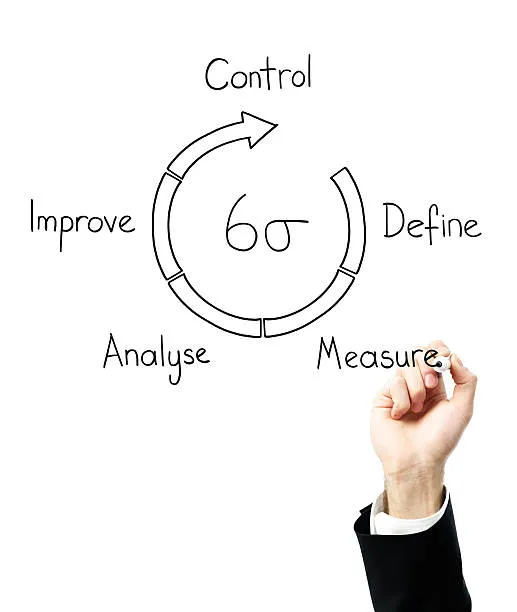
Six Sigma provides a structured approach, tools, and methodologies to enhance processes, improve quality, and drive organizational excellence. Its principles have become integral to many successful businesses worldwide in diverse industries.
The term “Six Sigma” is derived from the statistical concept of standard deviation, symbolizing a process operating with an exceptionally high level of precision, allowing only 3.4 defects per million opportunities.

1. Origin and Development
- Six Sigma was introduced by American engineer Bill Smith while working at Motorola in 1986.
- It was developed by Motorola in 1986 as a methodology for improving manufacturing processes.
- It gained widespread recognition after being successfully implemented at General Electric under the leadership of Jack Welch.
2. DMAIC Methodology
- Define: Clearly outline the problem, project goals, and customer requirements.
- Measure: Collecting data to establish a baseline and quantify the extent of the problem.
- Analyze: Identifying root causes through statistical analysis of data.
- Improve: Implementing solutions and process modifications to address identified issues.
- Control: Establishing control measures to ensure the sustained success of process improvements.
3. Roles and Responsibilities
- Champion: High-level executive providing sponsorship and support.
- Master Black Belt: Expert responsible for training and mentoring Black Belts and Green Belts.
- Black Belt: Leads and manages projects, focusing on full-time process improvement.
- Green Belt: Assists Black Belts while continuing regular job functions.
- Yellow Belt: Participates part-time in projects, typically at a basic level.
4. Tools and Techniques
- Statistical Process Control (SPC): Monitoring and controlling process stability and performance.
- Process Mapping: Visual representation of steps to identify improvement areas.
- Cause and Effect Analysis (Fishbone Diagram): Analyzing potential causes of problems.
- Regression Analysis: Examining variable relationships to understand their impact.
- Control Charts: Graphical representation of process variation over time.
5. Benefits of Six Sigma
- Improved Quality: Reducing defects and errors in processes.
- Increased Efficiency: Streamlining processes for greater productivity.
- Customer Satisfaction: Ensuring products and services meet or exceed customer expectations.
- Cost Reduction: Identifying and eliminating unnecessary steps and waste.
6. Certification Levels
- White Belt: Basic awareness.
- Yellow Belt: Familiarity with tools and processes.
- Green Belt: Proficiency in statistical tools and leading smaller projects.
- Black Belt: Mastery of statistical tools and leading larger, complex projects.
7. Industry Adoption
- Six Sigma has been widely embraced in various sectors, including manufacturing, healthcare, finance, and telecommunications.
- Organizations use Six Sigma to drive continuous improvement, reduce variation, and enhance overall business performance.
XXX