
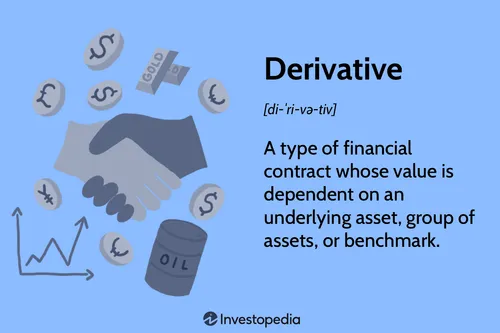
A derivative is a securitized contract whose value is dependent upon one or more underlying assets. Its price is determined by fluctuations in that asset.
Derivative transactions are financial contracts whose value is derived from the value of an underlying asset, index, rate, or event. These contracts allow investors and businesses to hedge risk, speculate on price movements, and manage exposure to various financial variables.
Derivatives can be traded on organized exchanges or over-the-counter (OTC), and they come in various forms.
Common types of derivative transactions:
- Forward Contracts
- A forward contract is an agreement between two parties to buy or sell an asset at a future date for a price agreed upon today. The contract specifies the quantity and price of the underlying asset.
- Futures Contracts
- Similar to forward contracts, futures contracts involve an agreement to buy or sell an asset at a future date for a predetermined price. However, futures are standardized contracts traded on organized exchanges.
- Options Contracts
- Options give the holder the right (but not the obligation) to buy or sell an asset at a predetermined price within a specified time frame. There are two types of options: call options (the right to buy) and put options (the right to sell).
- Swaps
- Swaps are agreements between two parties to exchange cash flows or other financial instruments over a specified period. Common types of swaps include interest rate swaps, currency swaps, and commodity swaps.
- Futures Options
- These are options contracts where the underlying asset is a futures contract. Traders can use futures options to hedge or speculate on the future price movements of the underlying futures contract.
- Credit Derivatives
- Credit derivatives allow parties to transfer credit risk. Common credit derivatives include credit default swaps (CDS), where one party pays a premium to another party in exchange for protection against the default of a specific credit instrument.
- Commodity Derivatives
- Derivatives can be based on commodities such as gold, oil, or agricultural products. Commodity derivatives help manage price risk for producers, consumers, and traders in the commodity markets.
- Equity Derivatives
- These derivatives are based on stocks or equity indices. Examples include stock options and equity futures, providing investors with a way to speculate on or hedge against movements in stock prices.
- Interest Rate Derivatives
- Derivatives tied to interest rates include interest rate swaps, options on interest rate futures, and forward rate agreements. These are used to manage interest rate risk.
While derivatives offer various benefits, they also involve risks, including the risk of substantial losses. It is important for market participants to understand the complexities of derivative instruments and the potential impact on their financial positions. Derivative transactions serve the following purposes:
- Risk Hedging – Participants use derivatives to hedge against potential losses due to adverse movements in the prices of underlying assets.
- Speculation – Traders and investors use derivatives to speculate on price movements, aiming to profit from anticipated market trends.
- Portfolio Diversification – Derivatives can be used to diversify investment portfolios and manage overall risk exposure.
- Price Discovery – Derivatives markets contribute to price discovery by reflecting market participants’ expectations about future asset prices.

XXX



2 thoughts on “Understanding the Versatility and Purpose of Derivative Transactions 💸”