Imagine when you want to build a new kind of machine – A really cool robot that can do amazing things. Now, instead of spending years and years making the perfect robot with all the bells and whistles, you decide to start with the simplest version that still does something cool. That simplest version is your Minimum Viable Product or MVP.
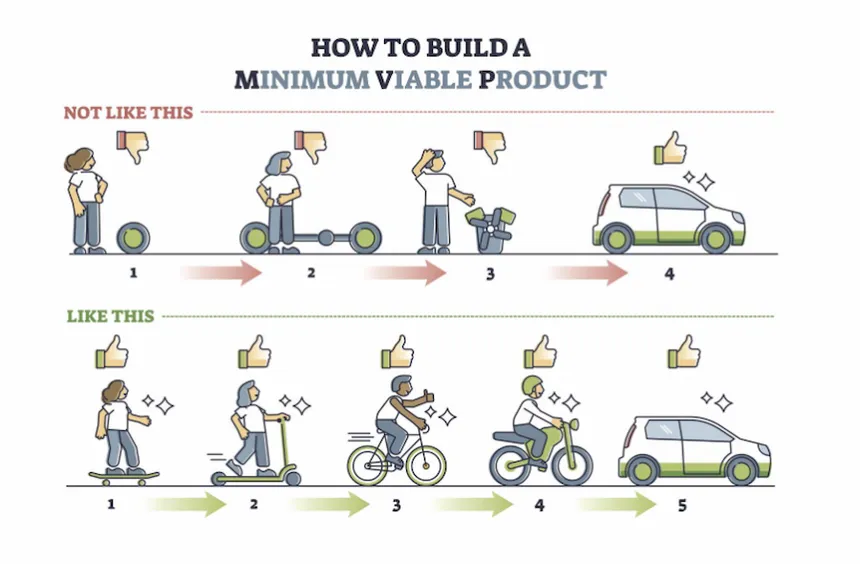
So, instead of waiting a long time to make the robot perfect, you build a basic version first. Maybe it can walk and talk a little, but it does not have all the fancy features yet. With this basic robot, you can show it to other people and see if they like it. They might give you feedback like, “I wish it could also dance” or “It would be even cooler if it could play music.”
The key is to create something simple but functional, just enough to see if people are interested and what improvements they might want. As you get feedback and make your robot better, you add more features and make it even cooler. The MVP is like the starting point that helps you learn what people like and what you can do to make your robot the best it can be.
For a Business Analyst, the concept of Minimum Viable Product (MVP) is a strategic approach to product development.
Imagine you are working on a new software or product for a company. Instead of trying to create the perfect, fully-featured product from the get-go, you start with the Minimum Viable Product. This is the most basic version of the product that still solves a problem or fulfills a need for your target audience.
The goal of the MVP is to quickly develop and launch a version of the product with the minimum set of features necessary to make it functional and valuable to users. By doing this, you can get the product into the hands of users as soon as possible and start gathering feedback.
The MVP concept is about efficiently delivering a product that meets the core needs of users, reducing risks, and incorporating feedback early in the development process. As a Business Analyst, your role is pivotal in guiding the identification of essential features and ensuring that the development process aligns with business objectives and user needs.
As a Business Analyst, your role in the MVP process involves:
- Identifying Core Features – Work closely with stakeholders to identify the essential features that the product must have to provide value. These are the features that directly address the primary needs of the users.
- Risk Reduction – Identify potential risks and uncertainties early in the development process. The MVP helps mitigate risks by allowing the team to test assumptions and hypotheses in a real-world environment.
- User Feedback – Facilitate the collection and analysis of user feedback on the MVP. This feedback is crucial for understanding user preferences, identifying pain points, and determining which additional features would add the most value.
- Iterative Development – Encourage an iterative development process. Iterative development is a process of breaking down the software development lifecycle (SDLC) of a large application into smaller chunks. As feedback comes in, the product can be refined and improved in subsequent iterations. This approach allows for flexibility and adaptation to changing requirements.
- Resource Optimization – Help the team optimize resources by focusing on the most critical features. This ensures that development efforts are concentrated on what matters most to users and the business.
🚀Serve a targeted audience
🚀Solve a primary problem
🚀Present the team with a better understanding of what to build
🚀Eliminate the risk of undesirable features, thereby spending less money on production
xxx