
Each century is characterized by its own unique historical events, cultural developments, and societal changes.
Centuries with their corresponding years:
- 1st Century: This century covers the years 1 CE (or AD 1) to 100 CE. It is often associated with the time when the Roman Empire was at its peak, and it includes significant events like the life of Jesus Christ.
- 2nd Century: This century spans from 101 CE to 200 CE. During this time, the Roman Empire continued to flourish, and there were developments in various fields such as science, philosophy, and literature.
- 3rd Century: The 3rd century encompasses the years 201 CE to 300 CE. It saw both the expansion of the Roman Empire and periods of crisis and instability, including the Crisis of the Third Century.
- 4th Century: This century covers the years 301 CE to 400 CE. It includes the early years of Christianity as it became more prominent in the Roman Empire. The Roman Empire itself went through significant changes during this time.
- 5th Century: The 5th century spans from 401 CE to 500 CE. It is marked by the fall of the Western Roman Empire in 476 CE, which led to the beginning of the Early Middle Ages in Europe.
- The 21st Century began on 1st January 2001 and will continue until 31st December 2100.
Year Of Updating This Article – Dated January 2023
xxx
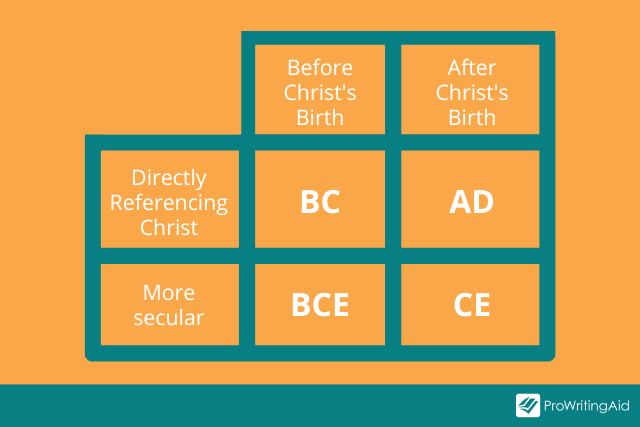
BC and BCE both refer to years before the birth of Jesus Christ, and AD and CE both refer to years after the birth of Jesus Christ. BC and AD reference Christ’s birth directly, while BCE and CE are more secular ways of telling time.
A complete guide to the abbreviations BC, AD, BCE, and CE, and help you remember when you use each term.
What Does AD Stand For?
The abbreviation AD stands for the Latin phrase Anno Domini, which means “in the year of our Lord.” You’ll often see AD placed before or after a number to refer to a year after the birth of Jesus Christ.
What Does CE Stand For?
CE stands for “Common Era.” It refers to the same years as AD does, just in a more secular way. The year 2022 CE is the same year as 2022 AD.
The Gregorian calendar, which is the dating system we use to measure years today, was created by the pope of the Catholic Church. That’s why it marks time-based on the birth of Jesus Christ.
Of course, there are many English speakers in the world who are members of other faiths, so it doesn’t make sense to mark all our calendars based on a single religion. That’s why CE is considered a more inclusive and secular way to say AD.
What Does BC Stand For?
BC stands for “Before Christ.” You’ll often see it placed before or after a number to refer to a year before the birth of Jesus Christ.
What Does BCE Stand For?
BCE stands for “Before Common Era.”
Just like how we use CE as a more secular way of saying AD, we also use BCE as a more inclusive way of saying BC. The year 500 BCE is the same year as 500 BC.
BC vs AD Meaning
BC and AD (as well as BCE and CE) make it possible for us to keep track of the year we live in, as well as when things happened in history.
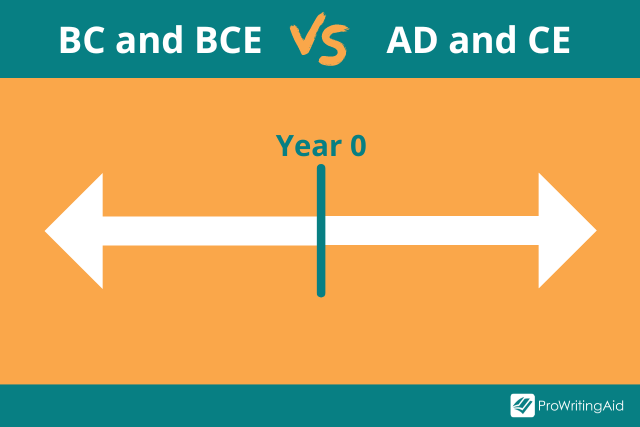
It might feel counterintuitive to have one set of years (AD) where we count forwards, and another set of years (BC) where we count backward. The reason we need these terms is that there’s no clear answer for what year to consider “Year 0.”
The Earth is about 4.5 billion years old, so if we started counting from the beginning of the Earth, we’d be living in the 4,500,000,000s, rather than the 2020s.
Humankind is only about 100,000 years old, so if we started counting from the beginning of humanity, we’d be living in the 100,000s.
Because there’s no natural “Year 0,” it makes much more sense to choose a year and start counting then. The Gregorian calendar uses the birth of Jesus as Year 0.
If you want to talk about something that happened a hundred years before Jesus Christ was born, you would write that year as “100 BC.”
If you want to talk about something that happened a hundred years after Jesus Christ was born, you would write that year as “100 AD.”
Tips for Remembering the Difference Between BC vs. AD
One easy mnemonic for remembering the difference between AD and BC is to think about the words before and after. BC starts with B, just like before. And AD starts with A, just like after.
Therefore, we use BC to talk about events before Year 0, and AD to talk about events after Year 0.
The same trick works for BCE vs. CE. BCE starts with a B, which means it’s the one that comes before Year 0.
🗝️
XXX