ChatGPT and Generative AI in Financial Services: Reality, Hype, What’s Next, and How to Prepare
ChatGPT is an artificial intelligence (AI) chatbot developed by OpenAI and released in November 2022. It is built on top of OpenAI’s GPT-3.5 and GPT-4 foundational large language models (LLMs) and has been fine-tuned (an approach to transfer learning) using both supervised and reinforcement learning techniques.
ChatGPT launched as a prototype on November 30, 2022, and garnered attention for its detailed responses and articulate answers across many domains of knowledge. Its propensity to confidently provide factually incorrect responses has been identified as a significant drawback. In 2023, following the release of ChatGPT, OpenAI’s valuation was estimated at US$29 billion. The advent of the chatbot has increased competition within the space, motivating the creation of Google’s Bard and Meta’s LLaMA.
The original release of ChatGPT was based on GPT-3.5. A version based on GPT-4, the newest OpenAI model, was released on March 14, 2023, and is available for paid subscribers on a limited basis.
ChatGPT, a conversational AI model built by OpenAI, has dominated tech conversation in 2023. Payments, banking, and insurance players are eager to understand generative AI’s potential and put it to work.
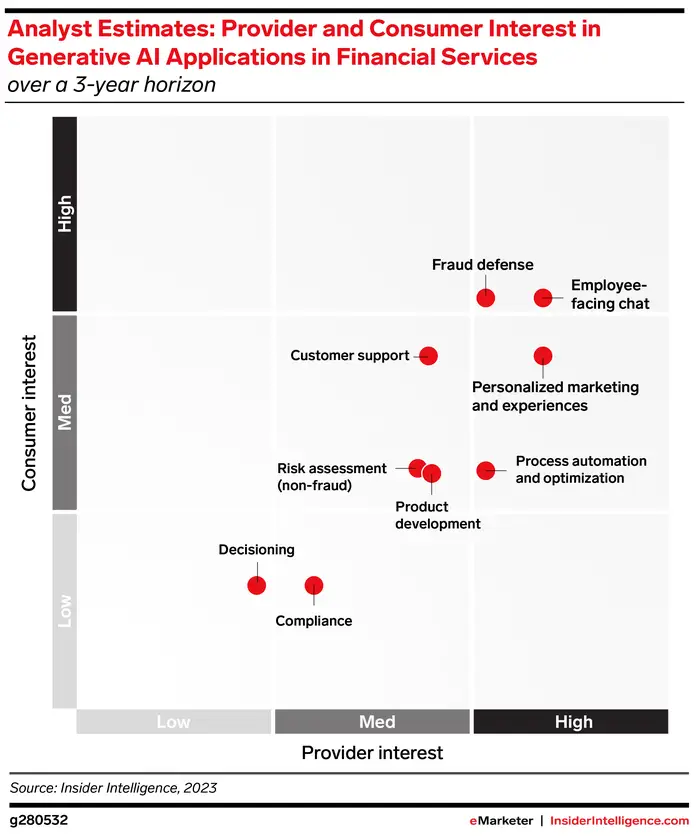
Generative AI has the potential to revolutionize financial services specifically in the payments, banking, and insurance sectors. The most promising use cases across the financial services space exist in personalized marketing and experience, process automation, fraud defense, risk assessment, customer success, and product development. Although there are many positive use cases, generative AI is not currently suitable for compliance, decisions, and high-risk areas such as securing payment systems or overseeing trading.
Generative AI’s rise seems sudden, but an industrywide embrace of the technology’s disruptive potential will take time. Early movers have the most to gain, so preparing for implementation now—or at least getting started—is paramount. In the full report, we delve into how generative AI could affect the financial services space, identify the most and least promising use cases, and define steps providers can take to prepare for its rise.
***